My information landscape has fundamentally changed in the last 15 years. While newspapers, radio, and television once set the standard, today often invisible algorithms filter what I see, hear, and read.
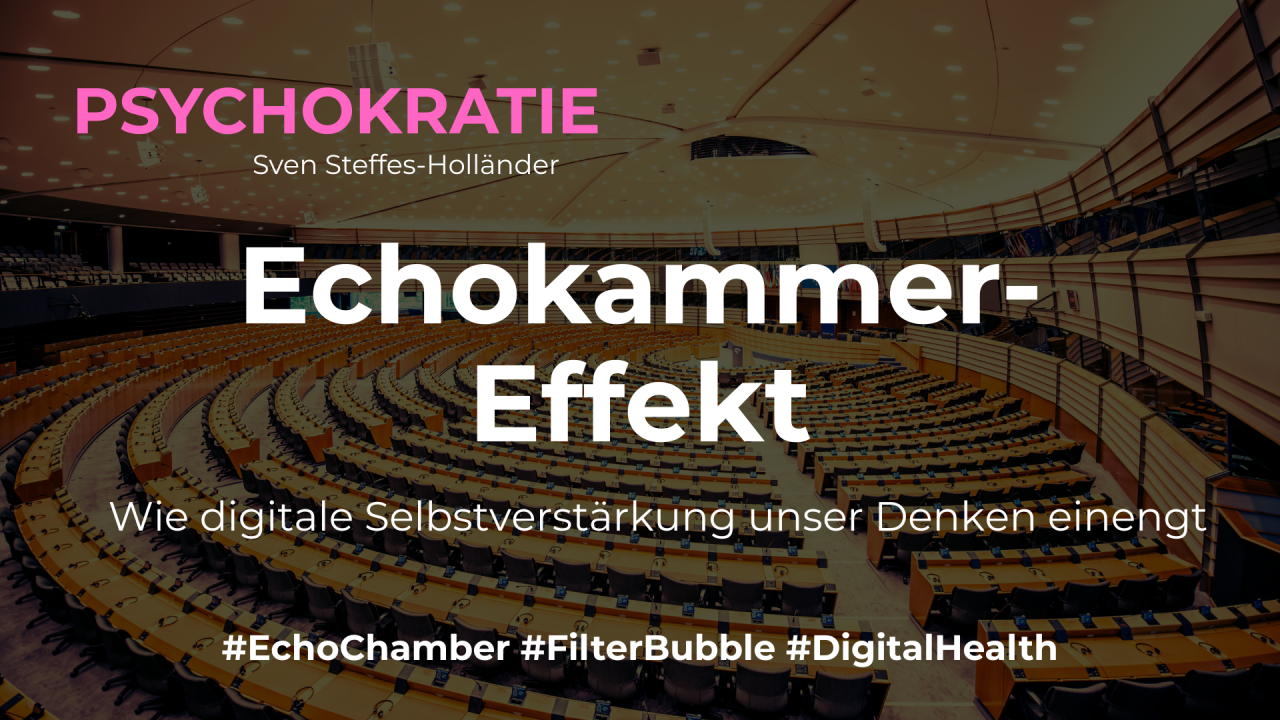
The echo chamber effect-How digital self-reinforcement limits our thinking
My information landscape has fundamentally changed in the last 15 years. While newspapers, radio, and television once set the standard, today often invisible algorithms filter what I see, hear, and read. Social media feeds are no longer mere news streams, but personalized realities in which the platforms show us what most closely confirms our existing views.
This digital comfort zone initially feels pleasant: We read what we already think, hear agreement instead of disagreement, and feel understood. But this is precisely where the danger begins. The echo chamber effect not only alters our thinking, but also our feelings, our communication, and our decision-making – with far-reaching consequences for mental health and social cohesion.
„If you listen to people like you, you'll probably get more extreme and more confident too.“
Cass Sunstein, Law School Professor Harvard University
What is the echo chamber effect?
The echo chamber effect describes how opinions, attitudes, or beliefs are reinforced in a closed communication environment through constant repetition and confirmation. In the digital realm, this means that users in groups, forums, or feeds predominantly see content that confirms their own point of view. Differing perspectives are often ignored or actively rejected.
While the term "filter bubble" primarily refers to algorithmic personalization, the echo chamber effect has a distinctly social component. It also arises through self-selection: We follow people with similar beliefs, join groups with shared interests, and avoid accounts that contradict our own. Studies show that this self-selection is a crucial factor (Guess et al., 2018). The interplay of algorithms and conscious selection leads to highly homogeneous information spaces in which narratives stabilize and alternative interpretations are rare.
Psychological mechanisms
At its core, this is confirmation bias: We seek out, evaluate, and remember information in a way that reinforces our existing beliefs. Digital echo chambers amplify this mechanism because they continuously deliver confirming messages. Every positive reaction – whether a like, comment or share – acts as a form of social validation and anchors one's own worldview not only intellectually, but also emotionally (Garrett, 2009).
In addition, there is selective information intake: content that contradicts one's own views is avoided or dismissed as unbelievable. Stroud (2010) showed that this promotes political polarization. Algorithmic proposals and group dynamics create positive feedback loops that increasingly suppress dissenting information.
Analyses by Del Vicario et al. (2016) show that clear content clusters form on the internet, between which there is hardly any exchange.
Avoiding cognitive dissonance also has psychological consequences: Contradictory information creates discomfort that we intuitively want to avoid. While echo chambers offer short-term relief, they restrict our thinking and actions in the long run.
„There is another problem. Echo chambers can lead people to believe in falsehoods, and it may be difficult or impossible to correct them.“
Cass R. Sunstein, Law School Professor Harvard University
When and how do echo chambers form?
Echo chambers arise from the interplay of technical, social, and psychological factors. Technically speaking, algorithms can favor content that has a strong emotional impact. Bakshy et al. (2015) found that Facebook users are less frequently confronted with opposing political content when their feed is personalized. Echo chambers emerge socially when groups organize around shared values and internally solidify their positions.
From a psychological perspective, they convey a sense of security because they reduce complexity and promote emotional balance. Studies show differences between the platforms: Cinelli et al. (2021) found that stronger echo chambers exist on Gab and Facebook than on Reddit, where there is a greater diversity of perspectives. Echo chambers become particularly visible in polarized debates, for example, during the COVID-19 pandemic or regarding climate issues.
Social and psychological effects
The consequences negatively impact social cohesion and mental health. Polarization means that homogeneous discourse spaces reinforce opinions and the willingness to compromise decreases (Stroud, 2010). Radicalization can occur when extreme positions gain acceptance within a group (Del Vicario et al., 2016). Emotional reactivity increases when people are rarely confronted with contradictions. In the long term, this can reduce their tolerance for ambiguity. Furthermore, psychological stress arises because the constant stimulation of the stress system can lead to sleep disturbances, increased irritability, and a feeling of constant threat.
Example: Health myths on TikTok
A recent example of the echo chamber effect is the spread of health myths on TikTok. A 2024 analysis from the University of Chicago showed that content on nutrition, fitness, and mental health became highly similar for many users within just a few days. For example, someone who had seen a video about "natural remedies" subsequently received more similar content, often without any scientific basis. Within a few weeks, isolated microcosms formed in which alternative, but false, health information became the sole truth. Such echo chambers not only pose a problem for public health, but also increase distrust of medical advice and can lead to risky behavior.
Stress physiology and social withdrawal
The effects of echo chambers on the psyche are not merely cognitive. Neuroscientific studies show that prolonged exposure to confirming, often emotionally charged content can alter the body's stress response system. Repeated states of arousal—for example, from shocking or frightening news—increase the release of stress hormones such as cortisol. In the long term, this can impair sleep quality, concentration, and emotional regulation.
At the same time, the willingness to maintain real-life social contacts decreases when digital interactions are perceived as more emotionally intense and predictable. This leads to a gradual withdrawal from complex, ambivalent social situations – thus reinforcing the echo chamber. In the long term, this can also undermine self-efficacy, as people gain less confidence in their ability to deal with unfamiliar or contradictory information.
Practical aspect: Consciously include contrasting experiences
To counteract this mechanism, it can be helpful to actively seek out "cognitive and emotional contrasts." This means consciously exposing oneself not only to information but also to different perspectives on an emotional level, for example, through podcasts by journalists from other cultural backgrounds, through exchanges with people outside one's own social bubble, or by attending events with mixed audiences.
The crucial point is to understand such experiences not as a threat, but as an opportunity to broaden one's horizons. In psychotherapy, this principle is applied as an "exposure exercise": one consciously confronts oneself with unfamiliar perspectives in order to increase tolerance for ambiguity and contradictions.
„Personalization filters serve a kind of invisible autopropaganda, indoctrinating us with our own ideas…“
Eli Pariser, The Filter Bubble
Ways out of digital one-sidedness
Algorithms often structure our information flow in such a way that we primarily perceive what confirms our existing beliefs. Counteracting this one-sided perception requires conscious effort. Regularly incorporating diverse perspectives trains cognitive flexibility and reduces susceptibility to confirmation bias.
1. Consciously broaden your perspectives: Instead of passively letting platform algorithms control the flow of information, it's worthwhile to actively seek out alternative viewpoints. This can mean consulting international media, listening to podcasts from other political perspectives, or subscribing to newsletters that deliberately represent a diversity of voices. From a neuropsychological perspective, this practice trains cognitive flexibility and reduces susceptibility to confirmation bias.
2. Foster ambiguity tolerance: The ability to tolerate uncertainty and contradictions is a key factor for psychological resilience. Studies show that people with high ambiguity tolerance are less susceptible to stress when confronted with complex or controversial information. This can be practically trained by consciously consuming content that does not align with one's own opinion and initially considering it without prejudice.
3. Create digital breaks and spaces for reflection. Constant online presence increases emotional reactivity. Targeted downtime, whether a social media-free Sunday or conscious breaks from the news, allows the nervous system to switch from a state of constant arousal to regeneration mode. From a psychophysiological perspective, this reduces the continuous activation of the stress system, particularly the hypothalamic-pituitary-adrenal (HPA) axis, and stabilizes emotional regulation.
4. Engage in personal conversations with people who think differently. Direct exchange without comments or likes can help regain empathy and a sense of nuance. In psychotherapy, this dialogical approach has proven itself for decades as a reliable method for dissolving entrenched thought patterns. In everyday life, this can be implemented by deliberately seeking out conversations with people from different professional, cultural, or political backgrounds.
5. Understanding media literacy as self-protection: Recognizing manipulative patterns—be it clickbait, emotionally manipulative images, or the selective use of statistics—is not just a journalistic task. For psychological well-being, it is essential to internalize source criticism as an everyday skill. Those who understand how information architectures function are less susceptible to unconscious manipulation.
Conclusion
The echo chamber effect is well-documented empirically. Studies confirm that self-selection and algorithmic filtering together lead to more homogeneous information environments, in which polarization, radicalization, and psychological stress become more likely. At the same time, data show that not all user groups are affected equally – factors such as media literacy, education, and social integration play a role.
Conscious media consumption, diverse sources (and by that I don't mean disinformation portals!), and openness can help break through the digital echo chamber. Actively seeking out contrasting perspectives not only trains cognitive flexibility but also strengthens psychological resilience. Breaking through echo chambers is not just an individual task but a societal necessity. Only where people meet despite their differences can genuine dialogue emerge and form the foundation of a vibrant democracy.
Psychocracy – How psychology shapes politics
Every two weeks, #Psychocracy sheds light on the psychological mechanisms behind political language, disinformation, and manipulative strategies such as coercive rhetoric.
Using current examples from politics and society, I show how narratives emerge, how the spectrum of acceptable opinions narrows, and what ways exist to revive democratic debates. Well-founded, critical, and accessible.
"All rights belong to Dr. med. Sven Steffes-Holländer"