
In the last decade, oyster restoration projects have had success, with over 40 hectares of sub-tidal reefs restored.
Can oyster reef restoration move into the intertidal? New evidence says yes — with caveats.
Over the last 150 years, the vast Australian flat oyster reefs that covered the seafloors of southern Australia’s bays and estuaries have disappeared. With less than 1% left, these ecosystems are functionally extinct, with the habitat, biodiversity, and water filtration it historically provided lost.
In the last decade, oyster restoration projects have had success, with over 40 hectares of sub-tidal reefs restored. But there is a long way to go, and learning where and how we can restore flat oyster reefs is critical.
Dr Kathy Overton and colleagues have published a new paper in Restoration Ecology that provides the first experimental evidence that the Australian flat oyster can survive and grow in the intertidal zone, challenging the long-held assumption that restoration must be subtidal.
Key result:
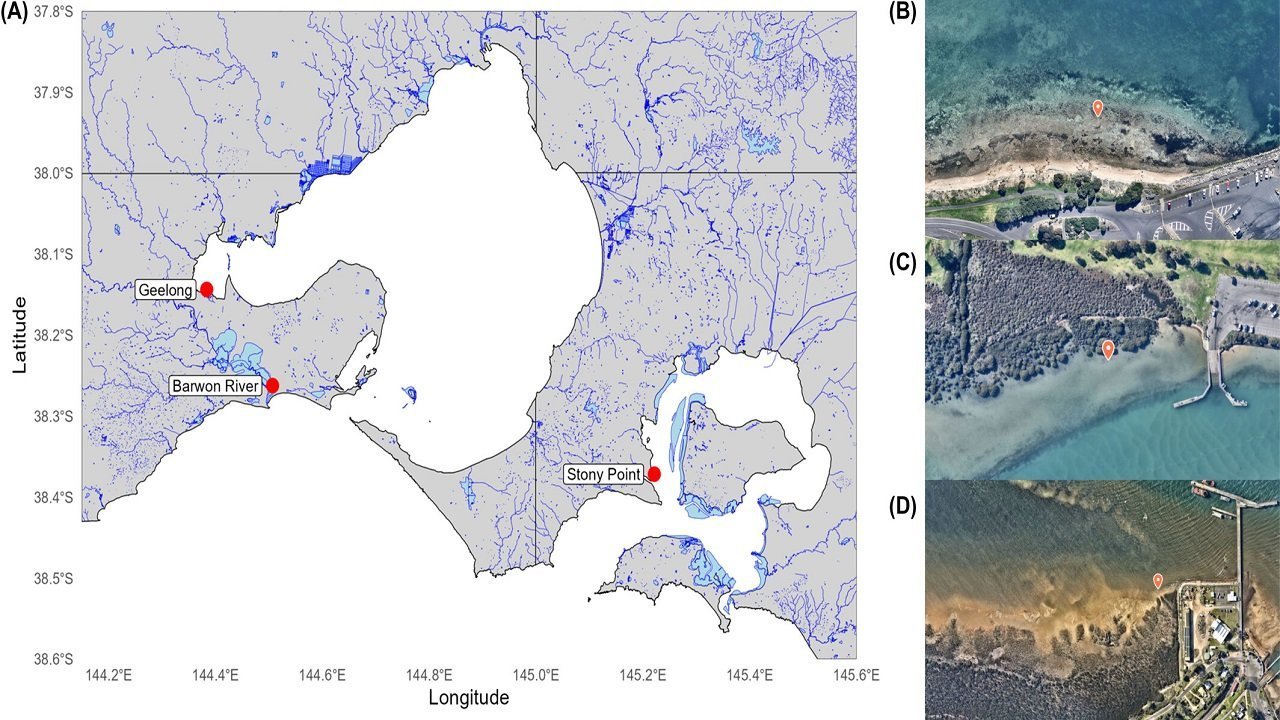
Juvenile flat oysters survived for more than 13 months across shallow subtidal to low-intertidal elevations at all three study sites in Victoria. Survival was highest at the lowest intertidal elevations and strongly site-dependent.
What we found:
-Survival increased as air exposure decreased, but only at some sites — site conditions matter.
-Mangroves improved oyster survival at the highest, most stressful elevations by buffering heat and light stress, although facilitation alone could not overcome extreme summer conditions.
-Co-location of oysters with seagrass did not improve survival or growth.
-Growth occurred across all sites, with the fastest growth generally at lower elevations, and some oysters approaching reproductive size.
Why this matters:
Intertidal restoration could complement subtidal oyster reef projects by reducing sedimentation risk, lowering costs, and increasing visibility and public engagement. Importantly, restoring oysters to accessible intertidal zones aligns with historical harvesting by First Nations peoples and offers new opportunities for community-based restoration.
The takeaway:
Intertidal flat oyster restoration is feasible — but success depends on careful site selection, elevation, and local stressors. Harnessing facilitation (e.g. mangroves) may improve outcomes, but it’s not a silver bullet. Expanding restoration into the intertidal opens exciting, practical pathways to rebuild functionally extinct shellfish ecosystems.
For full Restoration Ecology paper, see the link: onlinelibrary.wiley.com
"All rights belong to Prof. Tim Dempster"