
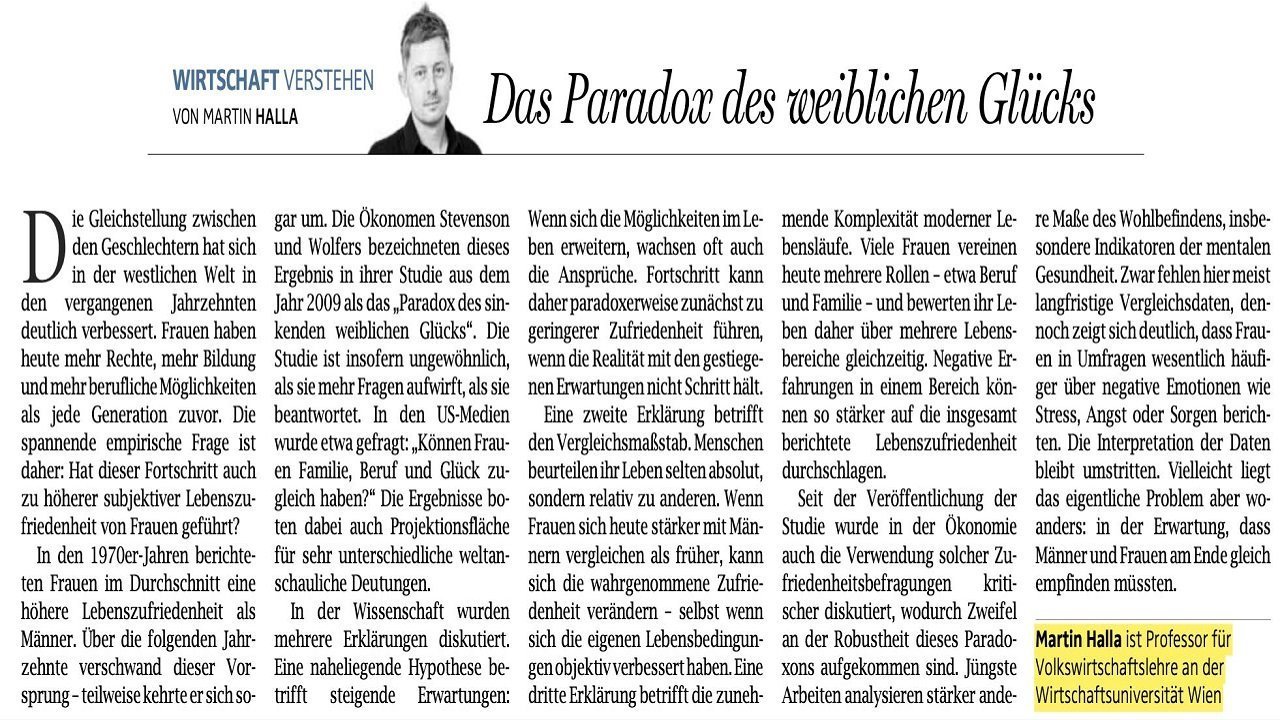
Gender equality has improved significantly in the Western world in recent decades.
The paradox of female happiness
Gender equality has improved significantly in the Western world in recent decades. Women today have more rights, better education, and more career opportunities than any generation before them.
The interesting empirical question, therefore, is: Has this progress also led to higher subjective life satisfaction among women? In the 1970s, women reported, on average, higher life satisfaction than men. In the following decades, this advantage disappeared – in some cases, it even reversed.
Economists Stevenson and Wolfers, in their 2009 study, referred to this finding as the "paradox of declining happiness in women." The study is unusual in that it raises more questions than it answers.
US media raised questions such as: "Can women have family, career and happiness at the same time?" The results also provided a basis for very different ideological interpretations.
Various explanations have been discussed in the scientific community. One obvious hypothesis concerns rising expectations: as life chances increase, so do demands. Progress can therefore paradoxically lead to lower satisfaction at first if reality does not keep pace with these increased expectations.
A second explanation concerns the scale of comparison. People rarely judge their lives in absolute terms, but always in comparison to others. If women today compare themselves more to men than in the past, their perceived satisfaction can change – even if their own living conditions have objectively improved.
A third explanation concerns the increasing complexity of modern lifestyles. Many women today combine multiple roles – such as career and family – and therefore evaluate their lives simultaneously in different areas. Negative experiences in one area can thus have a greater impact on overall reported life satisfaction.
Since the publication of the study, the use of such satisfaction surveys has been discussed more critically in economics, casting doubt on the validity of this paradox. More recent studies analyze other indicators of well-being more closely, particularly indicators of mental health. Although long-term comparative data are largely lacking, it is clear that women report significantly more negative emotions such as stress, anxiety, or worry in surveys.
The interpretation of the data remains controversial. Perhaps the real problem lies elsewhere: in the expectation that men and women should ultimately feel the same way.
"All rights belong to Martin Halla"