Prof. Tim Dempster
How noisy are salmon farms?
We often think about water quality, disease and nutrition in aquaculture. But one environmental factor is rarely discussed: sound.
Prof. Tim Dempster:
How noisy are salmon farms — and does it matter for fish welfare?
We often think about water quality, disease and nutrition in aquaculture. But one environmental factor is rarely discussed: sound.
Our new review published in Reviews in Aquaculture and led by Deakin University's Dr Kathy Overton explores the underwater soundscape experienced by farmed salmonids and what it means for fish behaviour, physiology and welfare. Here are the key takeaways:
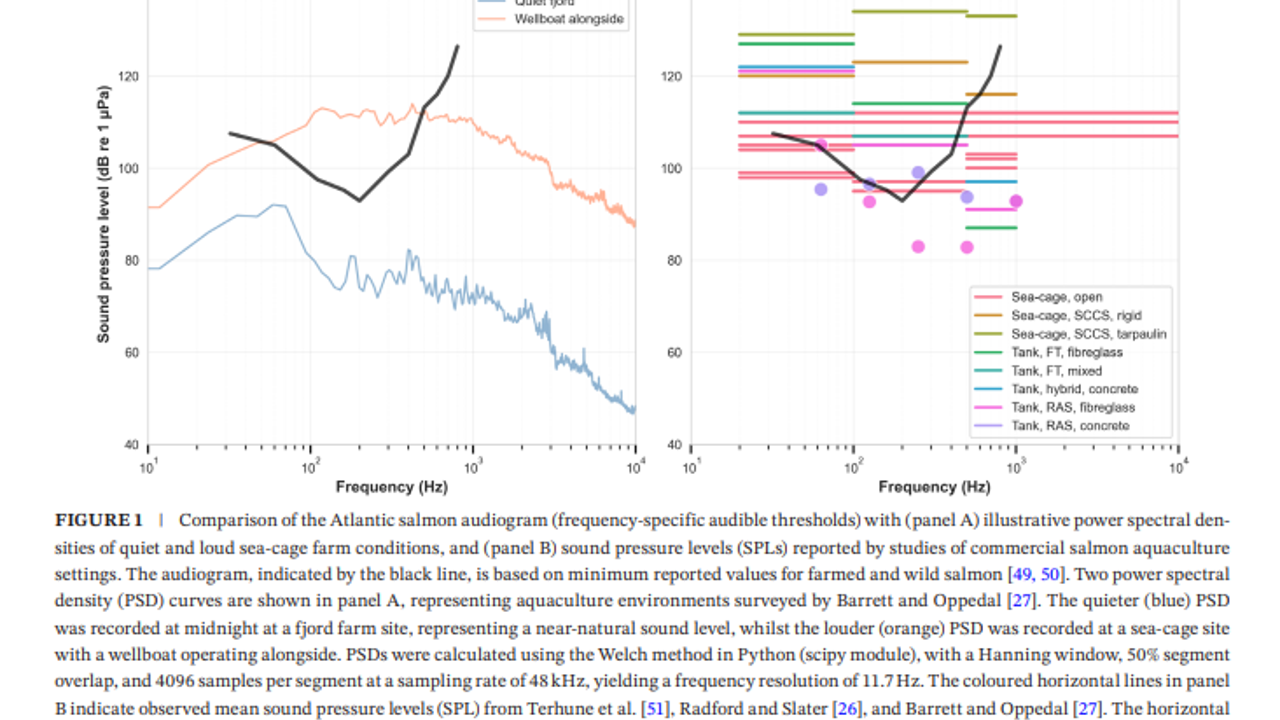
Fish don’t hear the same way humans do. Salmonids detect sound primarily through particle motion, sensed by the lateral line, making them most sensitive to low-frequency sounds (~7–400 Hz). These frequencies overlap with many common farm noises. Which raises an obvious question…
What does a salmon farm actually sound like underwater?
Modern aquaculture systems can be acoustically busy environments.
Typical sound sources include:
-Pumps and aerators
-Filtration systems
-Feed barges
-Workboats and wellboats
-Handling and treatment equipment
Reported sound levels at farms often range roughly 90–130 dB re 1 µPa, depending on system type. But noise alone isn’t the whole story. How do fish respond?
Across experiments, salmonids often show strong behavioural responses to low-frequency sounds, especially infrasound. Observed responses include:
-Startle reactions
-Increased swimming speed
-Avoidance behaviour
-Changes in swimming patterns
In some cases fish acclimate over time, but responses to infrasound may persist.
Evidence for physiological impacts is still limited, but some studies report:
-Stress responses (cortisol changes)
-Temporary hearing threshold shifts
-Immune responses
At extreme sound exposure levels, physical injury or mortality can occur, though these levels are rarely encountered in normal operations.
One striking finding from the review was that there are very few studies measuring the actual sound environment in aquaculture systems. And almost none measure particle motion, the component fish detect most strongly. This makes it difficult to define safe sound thresholds for farmed fish.
What should the industry do? Three priorities emerged:
1-Targeted research to establish safe noise thresholds
2-Standardised methods for measuring aquaculture soundscapes
3-Practical mitigation, such as isolating pumps, reducing vibration and using quieter vessels
Understanding aquaculture soundscapes may become an important frontier in improving fish welfare and production outcomes.
For the full article, you can find it here: onlinelibrary.wiley.com or make contact and we will send through a copy.
"All rights belong to Prof. Tim Dempster"